
Alcohol: The Uncomfortable Truth
I've lost two friends to it. My husband has lost three. All before fifty, all preventable.

No one wants to hear it. No one wants to see it. And almost no one wants to sit with it, because the uncomfortable truth is that alcohol is a poison. A glamorous, intoxicating, beautifully packaged one, but a poison nonetheless.
We’ve been here before. Smoking was once marketed as healthy. Endorsed by doctors, prescribed for stress, glowing in magazine ads with a physician’s smiling face beside it. We look back now and wince. And if you look closely, you can already see the same cracks forming in the story we’ve been told about alcohol.
And yet it’s the most normalised thing in the world. The wine we’re handed the second we walk through the door. The drink that means we’re fun, that we’re coping, that we belong.
This isn’t abstract for me
I’ve lost two friends to alcohol-related deaths, both at fifty. Between them, they left five boys without a mother. My husband has lost three friends before the age of fifty to alcohol, along with family members. All of it preventable. Every single death.
And it’s not only the deaths. For many years, I lived with an alcoholic, never knowing what state they’d come home in, whether it would be Jekyll or Hyde walking through the door. There was money lost. There were lies. There was aggression that arrived with the drink and left with the sobriety, over and over again. Anyone who has lived this will know exactly how awful it is: the hypervigilance, the walking on eggshells, the way you learn to read a mood before a single word is spoken. It changes you.
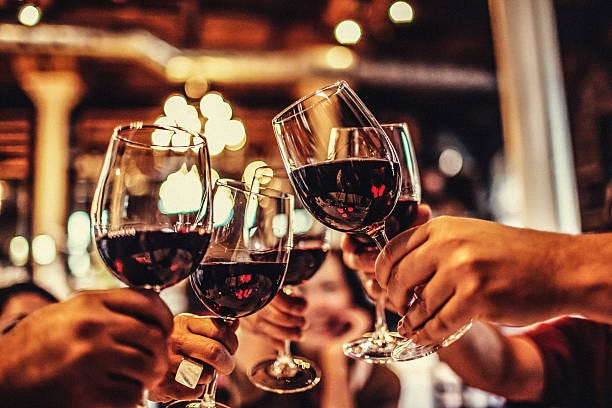
I watch it destroying the lives of people I know and people I work with, and it remains the one drug we hand out freely, pour generously, and celebrate at every milestone from birth to funeral. It’s the most readily available drug we have, and we don’t just permit it. We encourage it. We normalise it so completely that the moment you say “no thanks,” a strange thing happens: the discomfort becomes yours. What’s wrong with you? Why aren’t you drinking? As though sobriety were the thing that needed explaining.
Hello, drinking culture.
This is bigger than my story
In 2024, there were 1,765 alcohol-induced deaths in Australia, more than any other drug. The number and rate have climbed over the past decade. The median age at death was 58. Fifty-eight. That’s not “old age.” That’s a life cut short with decades still owed to it, to partners, to children, to the version of themselves they never got to become.
Men are dying at a decade-high rate. And researchers point directly at the culprits: rapid, largely unchecked home delivery, and sophisticated, targeted online marketing. The bottle shop is now in your pocket, open at midnight, one thumb-tap away. The marketing hasn’t disappeared since the smoking days. It’s just gotten smarter, quieter, and far harder to see.
How I found my way out
I didn’t set out to quit. Sobriety found me.
Years ago I went through eighteen months of a mould detox, and to heal I had to remove anything driving inflammation, which meant alcohol had to go. At first I genuinely struggled. Going out, standing in a room full of people drinking, feeling like the odd one out. It was hard in a way I hadn’t expected.
But then something shifted. After a while, I found myself again. A present version of myself. A version I actually loved, not the one who woke up foggy, flat, and heavy with regret, watching precious days of my one life disappear into a hangover.
Around that time I read Sober Curious by Ruby Warrington, and it cracked something open. It gave language to what I was already feeling: that the question isn’t “what’s wrong with me for not drinking?” It’s “why did I never question the drinking in the first place?”
There’s a name for it now
If you’ve ever felt it, that low, persistent hum that starts creeping in around 4pm. The internal negotiation. I’ll just have one. It’s been a big week. Everyone else is. The way a quiet evening can feel somehow incomplete without it. There’s a name for that now. Some people call it the booze noise: the mental chatter that isn’t really you talking, but the substance talking through you.
And here’s what fascinates me as someone obsessed with the science of the brain. We’re now watching that noise get turned down in real time. The GLP-1 medications everyone’s discussing for weight loss, the Ozempics and Wegovys of the world, were designed to quieten “food noise,” the relentless mental chatter about food. But researchers kept noticing something they hadn’t gone looking for: patients were also drinking less. Not because they were trying to. The desire simply faded. In 2025, a randomised controlled trial published in JAMA Psychiatry confirmed it.
Low-dose semaglutide significantly reduced alcohol craving and heavy drinking in adults with alcohol use disorder. These drugs act on the brain’s reward circuitry, the very same dopamine pathways that alcohol hijacks. (To be clear: they aren’t approved for this, and I’m not suggesting anyone reach for a medication. The research is still early.)
And for some people, the pull is even stronger, because they aren’t starting from the same baseline as everyone else. Researchers describe a kind of dopamine deficit, or a naturally higher need for dopamine, that can leave some brains running low on the very chemistry that makes us feel calm, motivated and okay.
Alcohol and other drugs flood that gap, artificially and only temporarily. It’s why you’ll so often hear someone say the booze “levels me out,” or “makes me feel normal.” They aren’t chasing a high. They’re chasing baseline: the ordinary sense of okayness that others seem to get for free. That isn’t a willpower problem. That’s biology.
And that’s the reframe I most want you to take from all of this. The noise was never a moral failing. It was neurology. If a medication can turn the volume down, and if some people are simply wired to feel the pull more fiercely, then the volume was real all along. A biological signal, not a character flaw. Which brings me to a question worth sitting with.
The tide is genuinely turning
Here’s the part that gives me hope. My boys, nineteen and twenty-three, barely drink. And they are not the exception. They’re the leading edge of a genuine generational shift.
And I don’t think it’s an accident. This is the generation that watched their parents get drunk, who saw the slurred words, the arguments, the hangovers, the version of the adults they loved that alcohol handed back to them the next morning, and quietly decided not to go down that same path. They’re not rejecting alcohol because it’s trendy to. They’re rejecting it because they’ve seen, up close, exactly what it costs.
A 2025 Flinders University study tracked more than 23,000 Australians across two decades and found abstinence rising and weekly drinking falling, especially among the young. Over the course of their lives, Gen Z are nearly 20 times more likely to choose not to drink than Baby Boomers, and the researchers are clear this is a sustained change, not a passing phase. The proportion of young people who’ve never had a full glass of alcohol has more than doubled since 2001.
Turns out you don’t need a drink in your hand to be interesting, to belong, to celebrate, to grieve, to live. A whole generation is quietly proving it.
What I want you to take from this
I’m not here to shame anyone. I drank for years. I understand the pull, the ritual, the way a glass of wine can feel like the only pause in a relentless day.
But before you scroll on, I want you to take a moment and ask yourself, honestly: what is my relationship with alcohol actually like? Not whether you have a “problem” by some clinical definition, but the quieter, more revealing question underneath it. Who is in control of who? That booze noise, is it yours, or is it the alcohol’s? Are you reaching for it, or is it reaching for you? Could you take it or leave it for a month, and does the flicker of resistance you feel reading that tell you something?
I’ve buried too many people to stay quiet, and I’ve felt too good on the other side to pretend it doesn’t matter. So I’ll leave you with the question that changed everything for me. Not should I quit?, but simply, what would it feel like to meet the present version of myself?
You don’t have to have all the answers today. You just have to be willing to get curious.
If any of this landed, this is exactly the kind of preventable, controllable health decision I explore in my work: the small, evidence-based shifts that protect your brain, your body and your future self.
If you’re struggling, with your own drinking, or with loving someone whose drinking is hurting you, please know you’re not alone, and support is free and confidential.
National Alcohol and Other Drug Hotline — 1800 250 015. Free, confidential, 24/7. For anyone worried about their own drinking or someone else’s. Connects you to the service in your state or territory.
Al-Anon Family Groups Australia — support specifically for the families and friends of someone whose drinking is a problem. al-anon.org.au
Family Drug Support — 1300 368 186. A 24-hour line for families and loved ones navigating someone else’s alcohol or drug use.
Lifeline — 13 11 14. 24-hour crisis support, if things feel overwhelming.
If you or someone else is in immediate danger, call 000.
A really great read Camilla thank you. My eldest is 27 - we have never had more than 2 beers together. He’s seen me break body parts as a result of a boozy nite back in the day - and as you point out he saw the hangovers - and is part of that generation that can take it or leave it.
I was at a certain someone’s 60th+1 just a few weeks back and had only one beer that night - as against making it an all niter - it was eye opening to be there sober.
Big love - great piece keep em coming ✌️🙏